NVIDIA's Nemotron 3.5 Bolt 74B Brings 74B AI Models to Local Hardware
NVIDIA introduces Nemotron 3.5 Bolt 74B, a 74 billion parameter model designed for local AI agents, alongside PAIR, an open source tool for distributing AI workloads across multiple computers.
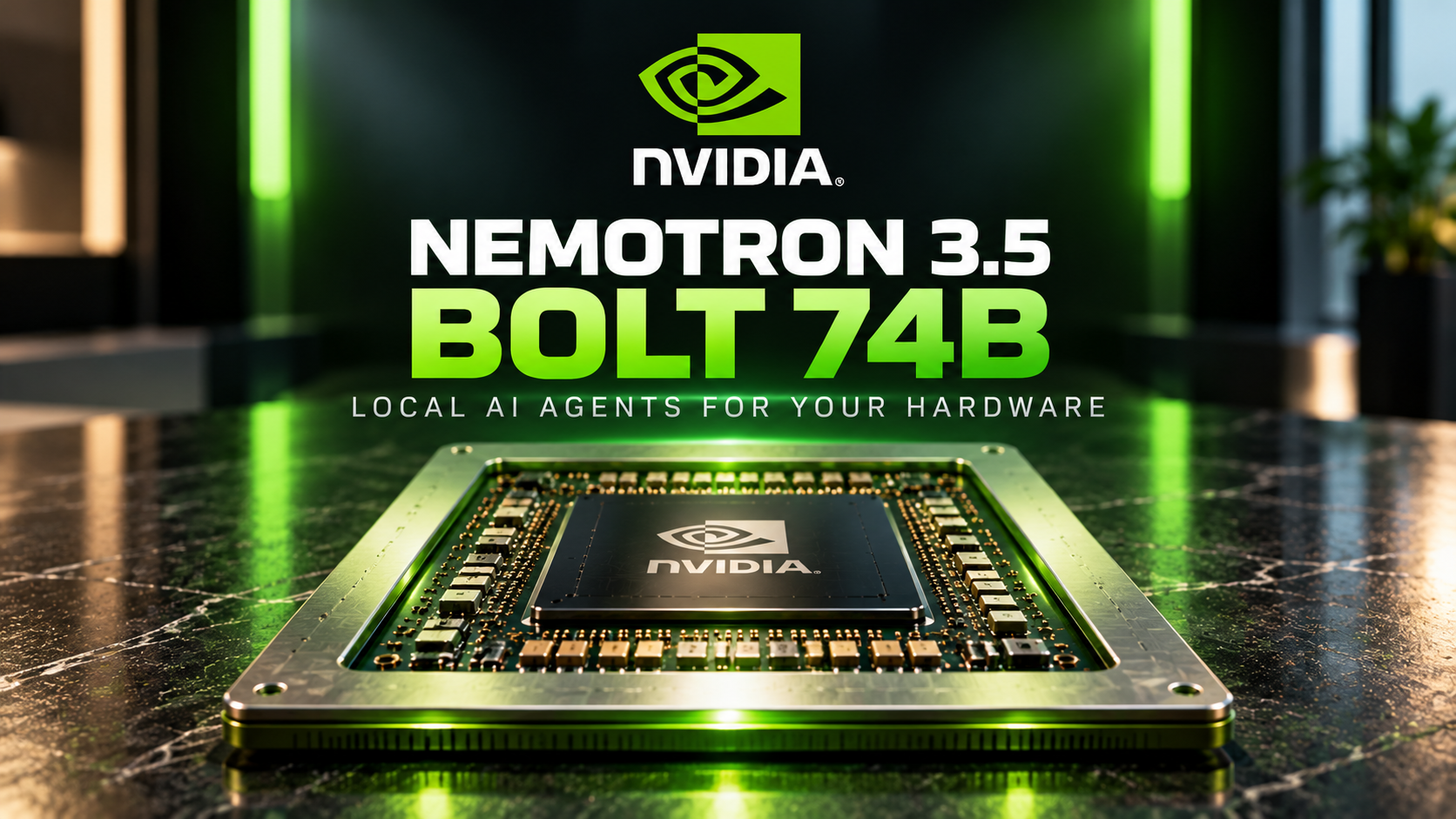
NVIDIA is making a serious push into local AI agents with a new language model designed to fit an unusually large number of parameters into just 24 GB of memory. The upcoming Nemotron 3.5 Bolt 74B combines a 74 billion parameter mixture of experts architecture with aggressive 2 bit quantisation, targeting developers who want capable AI agents running on their own hardware.
Alongside the model, NVIDIA is releasing an updated version of its Personal AI Router, a free, open source tool designed to distribute AI workloads across multiple computers on a local network.
The announcements form part of NVIDIA's expanding local AI ecosystem ahead of the RTX Spark launch on 16 October 2026.
What Is NVIDIA Nemotron 3.5 Bolt 74B?
Nemotron 3.5 Bolt 74B is a language model specifically designed for agentic AI applications. Rather than focusing exclusively on conversational responses, the model targets systems that can reason through tasks, call tools, and interact with software.
According to NVIDIA, the model will become available on 15 October 2026.
Its key specifications include:
- Total parameters: 74 billion
- Active parameters: 9 billion per token
- Memory footprint: Approximately 24 GB
- Architecture: Mixture of experts (MoE)
- Quantisation: 2 bit, using quantisation aware training techniques
- Primary use case: Local AI agents and automation
- Availability: Model release planned for 15 October 2026
NVIDIA says the model will be available through supported inference frameworks, including llama.cpp, and can be integrated with agent platforms such as Hermes and OpenClaw.
Developers will also be able to customise and fine tune the model using its released weights, training data, and recipes.
Source: NVIDIA's official announcement.
How Can a 74 Billion Parameter Model Fit Into 24 GB?
The answer comes down to two techniques: mixture of experts and quantisation.
Mixture of Experts
A conventional dense language model uses most of its parameters to process every token. A mixture of experts model takes a different approach.
Instead of activating the entire model for each token, a routing mechanism selects a subset of specialised components, known as experts, to perform the computation.
Nemotron 3.5 Bolt 74B contains 74 billion total parameters but activates approximately 9 billion per token.
This can significantly reduce the computation required to generate responses compared with a dense model of similar total size.
However, fewer active parameters do not mean the model only needs memory for 9 billion parameters. The full collection of model weights must still be stored or made accessible during inference.
Two Bit Quantisation
Quantisation reduces the precision used to represent model weights, lowering memory requirements and potentially improving inference efficiency.
Most commonly used local language models are distributed in formats using higher precision or 4 bit quantisation. NVIDIA is pushing further with a 2 bit representation for this model.
At two bits per parameter, the theoretical storage requirement for 74 billion parameters is approximately 18.5 GB before accounting for additional overhead. This helps explain how the model can target a 24 GB memory footprint.
The challenge is preserving useful reasoning and language capabilities while compressing the weights so aggressively.
NVIDIA says it uses quantisation aware training techniques to retain model quality. Independent evaluations will be needed to establish how well this approach performs across different tasks.
Why Is NVIDIA Building Models for Local AI Agents?
AI agents represent a shift from systems that simply answer questions towards systems that can carry out multi step tasks.
For example, a business agent might retrieve information from a CRM, analyse recent sales, identify overdue follow ups, and prepare a report for a manager.
The model provides reasoning and tool selection capabilities, while the surrounding application controls access to external systems and determines which actions the agent is permitted to perform.
Running this type of system locally offers several potential advantages:
- Privacy: Sensitive information can be processed without automatically sending every prompt to a remote inference provider.
- Control: Businesses can choose their own models, deployment configurations, and access policies.
- Availability: Local inference can continue without an internet connection, provided the necessary software and dependencies are available.
- Predictable infrastructure: Organisations can operate their own inference systems rather than depending entirely on external API availability and pricing.
Local deployment still requires appropriate hardware, security controls, and software integration. An AI model alone does not provide a complete autonomous business system.
What Is NVIDIA PAIR?
NVIDIA PAIR stands for Personal AI Router. It is a free, open source tool designed to connect compatible computers and distribute AI inference workloads across a local network.
The software is officially moving out of beta on 14 October 2026.
According to NVIDIA, PAIR can automatically discover compatible devices, connect systems, install models and inference engines, and distribute workloads across available computers.
The updated release adds support for llama.cpp, direct model downloads from Hugging Face, customisable inference settings, and compatibility with RTX Spark.
PAIR supports Windows, Linux, and macOS.
Source: NVIDIA's PAIR announcement.
Why Distributed Local AI Matters
Most people experimenting with local AI start with a single computer. Performance is limited by the available RAM, GPU memory, processing power, and inference software.
Distributed inference offers another option: combining resources across multiple machines.
Imagine a small office with three computers. Rather than treating each machine as an isolated system, a compatible distributed setup could make their available computing resources useful to a shared AI environment.
This could make it easier to experiment with larger workloads without immediately purchasing a dedicated server.
There is an important distinction, however. Distributing independent requests across several computers is not the same as splitting one model across them. The performance benefits depend on the software architecture, network bandwidth, workload, and supported hardware.
PAIR aims to simplify the process of connecting local AI resources, but its real world performance will depend on the configuration being used.
What Is NVIDIA RTX Spark?
RTX Spark is NVIDIA's upcoming personal computing platform designed to bring substantial AI computing capabilities to compact systems.
NVIDIA describes the platform as offering up to 128 GB of unified memory and one petaflop of AI compute, with availability beginning on 16 October 2026.
The platform is designed for developers, creators, and users who want to run AI models and agents locally.
Nemotron 3.5 Bolt 74B is being positioned as one of the models that can take advantage of this hardware, with its 24 GB memory footprint intended to make a 74 billion parameter model practical within the platform's available memory.
However, the model is not necessarily restricted to RTX Spark. Its usefulness on other systems will depend on compatible inference software, available memory, and hardware performance.
For developers with existing computers, the more interesting question is whether the model can be run efficiently on their current hardware rather than whether they need to purchase a new system.
What Does This Mean for the Future of Local AI?
NVIDIA's announcements highlight two developments worth watching.
First, aggressive quantisation and mixture of experts architectures are making it possible to experiment with increasingly large models within constrained memory budgets.
Second, local AI infrastructure is moving beyond individual computers. Tools such as PAIR aim to make multiple machines function as a more connected environment for AI inference.
Together, these developments could make advanced local agents more accessible to developers and small businesses.
There are still practical limitations. Quantisation can affect model quality, distributed workloads introduce networking overhead, and larger models continue to require substantial computing resources. Vendor performance claims also need to be tested independently.
Nevertheless, the direction is clear: local AI development is increasingly focused on useful agents, efficient inference, and making better use of the hardware people already have.
Final Thoughts
Nemotron 3.5 Bolt 74B is an interesting upcoming release because it combines a 74 billion parameter model with a target memory footprint of just 24 GB. Its mixture of experts architecture reduces the number of active parameters per token, while 2 bit quantisation further reduces the memory required to store the model.
At the same time, NVIDIA PAIR addresses a different problem: making local AI resources easier to connect and manage across multiple computers.
Neither development eliminates the hardware and engineering challenges of running capable AI agents. Both, however, point towards a future in which local AI systems can handle more demanding workloads without relying entirely on cloud inference.
For developers building private AI assistants, automation systems, and local agent platforms, these are developments worth following as the models and tools become available.
Frequently Asked Questions
When will Nemotron 3.5 Bolt 74B be released?
NVIDIA has announced availability for 15 October 2026. The model has not yet reached its announced release date as of 14 October.
Can a 74 billion parameter model really fit into 24 GB?
NVIDIA says Nemotron 3.5 Bolt 74B uses 2 bit quantisation and quantisation aware training to achieve a 24 GB footprint. Actual memory requirements will depend on the model files, inference implementation, and runtime overhead.
What does 9 billion active parameters mean?
The model contains 74 billion parameters in total but activates approximately 9 billion per token. This reduces the computation required for each token, although it does not reduce the total number of model weights that must be stored or accessed.
Is NVIDIA PAIR free?
Yes. NVIDIA describes PAIR as free and open source software for discovering compatible computers and distributing AI workloads across a local network.
Can I use PAIR with ordinary computers?
PAIR supports Windows, Linux, and macOS. The benefits and compatibility of a particular setup depend on the available hardware, supported inference engines, and network configuration.
Does local AI require an internet connection?
Not necessarily. Once model files and dependencies are installed, local inference can operate offline. Downloading models and using remote integrations or online services still requires network access.


